
Searching the Rusk County Court Docket
Every Rusk County case lookup starts with the court named on your paperwork. Grab the notice, citation, or order and read the court line first. That single detail tells you which clerk to call. The Rusk County District Clerk holds the 4th Judicial District Court records. Those span district civil, criminal, and family matters. Its iDocket link gives a name and filing index. The Rusk County Clerk covers constitutional County Court work and other county-level records. County Court at Law settings live on that court's own calendar page.
No single Rusk County court docket portal gathers every court. Use iDocket for the district index, and check the county pages for posted calendars. re:SearchTX adds statewide records where integrated. Is a result missing or muddy? Call the responsible clerk by phone, mail, email, fax, or at the counter. Say plainly what you need. A name search, a copy, a certification, or a current-setting check?
- Identify the issuing court and case type.
- Check that court's index or calendar.
- Try the statewide portal where coverage applies.
- Confirm the result with the record keeper.
Rusk County's Three-Door Court Map
Think of Rusk County as three doors. District felony cases, higher-value civil disputes, and family matters usually go through the District Clerk. County misdemeanors, probate, and mental-health cases run through the county-level court and clerk structure. County Court at Law settings run there too. The third door is different. Fine-only traffic cases, evictions, small claims, and city ordinance matters may fall to one of five justice precincts or to a separate municipal court.
| Starting point | Likely docket | First channel |
|---|---|---|
| District Clerk | District civil, felony, family | iDocket or clerk desk |
| County structure | Misdemeanor, probate, County Court at Law | Calendar or County Clerk |
| JP or city court | Traffic, Class C, eviction, small claim | Issuing court |
Federal cases sit outside these local doors. Federal civil and criminal matters route to the Eastern District of Texas Tyler Division, while bankruptcy runs through a separate Tyler system.
Inside a Rusk County Court Docket
A docket is a case diary, entry by entry. Expect the case number, the court, the parties, filing dates, document labels, settings, orders, and disposition events. A calendar PDF is narrower, sometimes listing only the matters set for one day or docket call. And an iDocket entry can name a filing without giving you a certified image of it.
Read entries with care. A filing date is not the event date. A setting on the Rusk County docket does not prove a hearing happened. And a receipt is not a certified disposition. Entries change when a hearing resets, an order is filed, or access gets restricted.
| Case number | The court's file identifier |
|---|---|
| Entry date | When activity was posted or filed |
| Setting | A planned hearing, call, or trial event |
| Disposition | The result entered in the case |
Rusk County's Split Clerk System
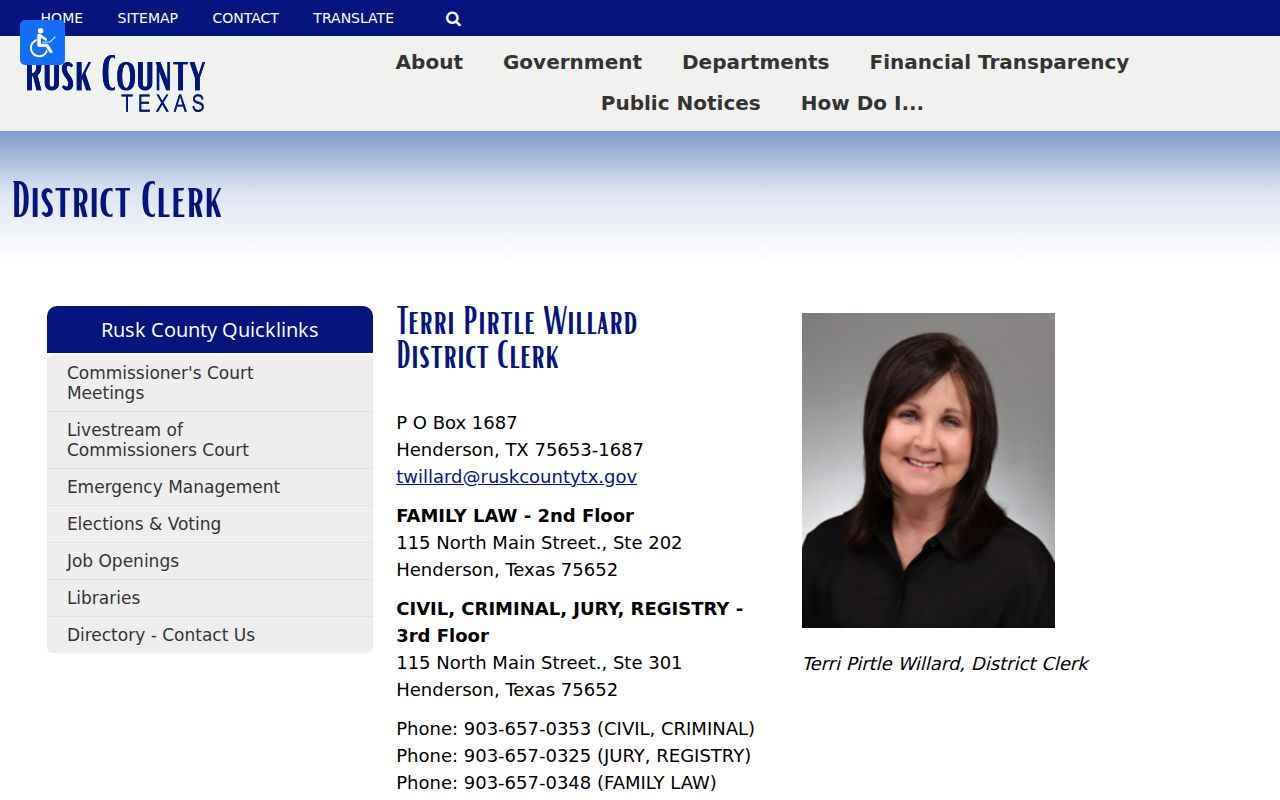
Two offices split the record work. District Clerk Terri Pirtle Willard keeps the 4th Judicial District Court files. That means civil, criminal, and family matters. Family law service sits on the courthouse's second floor, with civil, criminal, jury, and registry work on the third. A records search costs $5 per name. The office sends documents by email, fax, or mail, with copy charges added. Payments can be cash, money order, cards, or business checks. Personal checks are out.
County Clerk Trudy McGill maintains constitutional County Court records and the other county routes. Her office lists filing cutoffs, a midday vault closure, and public-computer shutdown times ahead of closing. Those hours can shape an in-person Rusk County court record search. Property and vital-record portals are handy. They are no substitute for a court docket. The official District Clerk page lays out the public search and office routes.
The official County Clerk page supplies the other half of the routing puzzle.
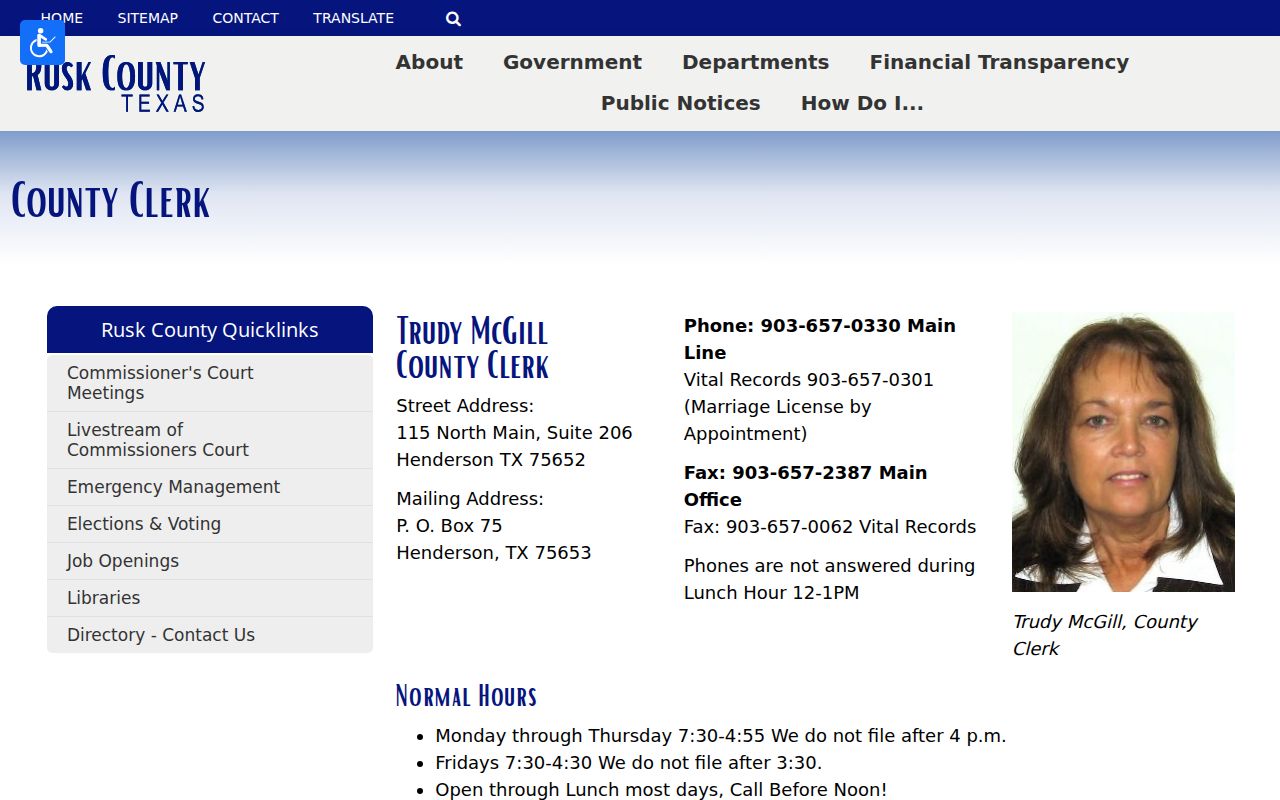
Its office details show why county and district records are not one database.
Rusk County Courts and Their Dockets
The 4th Judicial District Court is the county's main general-jurisdiction trial court. Its page posts forms and scheduling resources. It also posts live-stream access and criminal docket links. The constitutional County Court carries its own criminal, probate, and mental-health role. County Court at Law takes misdemeanor, civil, family, and juvenile work. It publishes a daily calendar.
Five Justice of the Peace courts split Rusk County by geography. They hear civil claims up to $20,000, evictions, fine-only criminal and traffic matters, and certain administrative hearings. Each precinct clerk sets its own docket. Municipal courts in Henderson, Kilgore, Overton, Tatum, and Mount Enterprise handle city Class C, traffic, parking, and ordinance cases. Each runs on its own schedule. The official District Court page shows the local forms and scheduling routes.
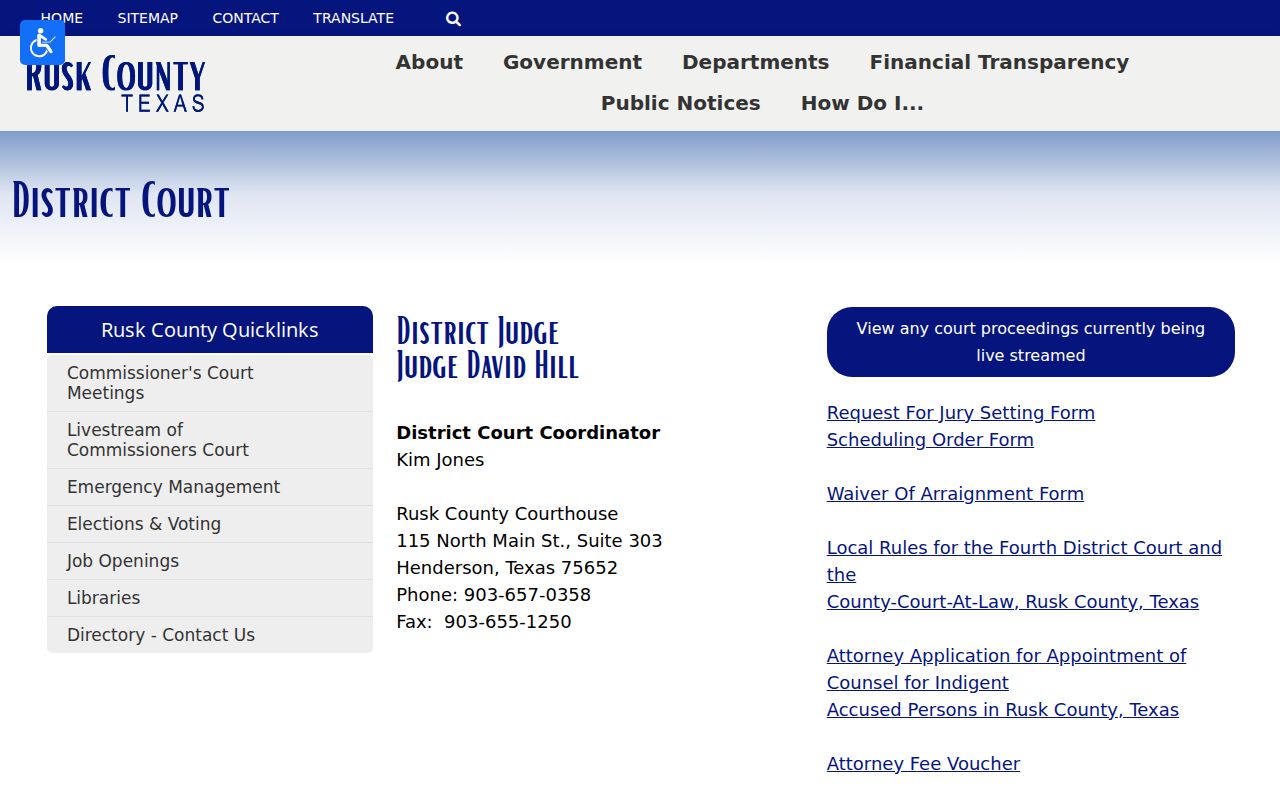
The court page starts a setting search; the District Clerk keeps the case file.
The Rusk County Search Ladder
Rusk County spreads its work across several systems. iDocket is the county-linked district index. It offers name, case display, and advanced search tools. re:SearchTX adds a signed-in statewide layer for integrated courts. It shows case, filing, hearing, and document details. Neither screen proves every local record type is online.
eFileTexas serves filers, not the public docket. NetData is the local case-management system. But no direct public NetData login is published. When the online layers miss what you need, contact the clerk. Ask what your purpose calls for. A plain copy, a certified copy, or a certified disposition?
Fast answer: A blank result does not prove no case exists. Check spelling, court, date range, access limits, and then call the clerk.
How to Find Court Dates and Settings
Current Rusk County court dates come from the court that set the event. The District Court criminal page lists felony arraignments and trials. It also covers pretrial or docket calls and grand-jury dates. County Court at Law publishes a daily calendar plus docket and jury links. Justice and municipal courts keep their own schedules.
Trust the live page, not an old downloaded PDF. Confirm with the coordinator or clerk. The district schedule can separate jail defendants at the Justice Center from other defendants in the third-floor courtroom. County Court at Law instructions tell counsel to check the current daily calendar. Counsel should then coordinate proposed times. Any setting can move. The County Court at Law page gives current calendar access.
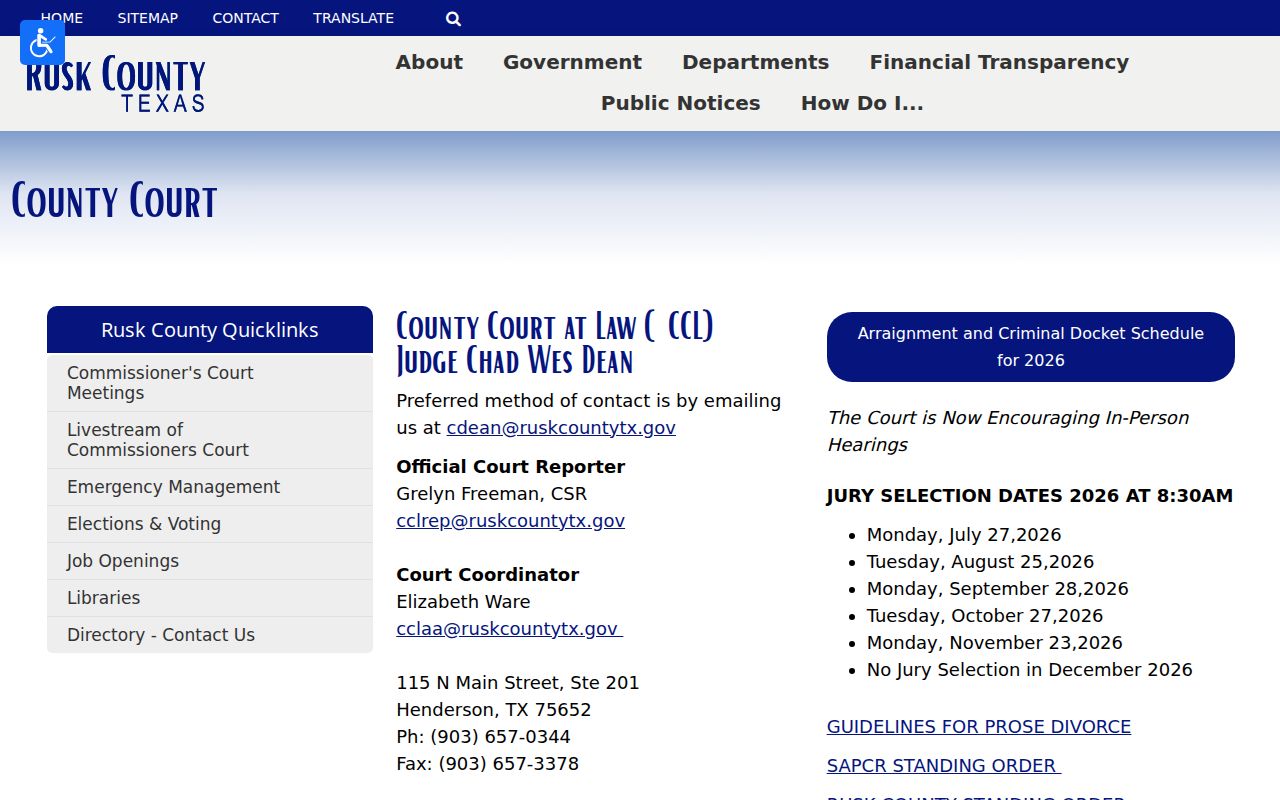
The calendar helps with current settings; the clerk file supplies the broader history.
A Rusk County Date Is Not an Outcome
Don't read too much into a Rusk County calendar label. An arraignment is a formal step, not a verdict of guilt, and a pretrial setting usually just sorts out motions, readiness, or timing. A docket call keeps pending cases organized. Continuances and resets shift dates rather than settle anything. No label on the calendar is a final result.
- Docket call
- A session used to check status and readiness.
- Setting
- A scheduled event on a calendar or docket.
- Continuance
- A court-approved move to a later date.
- Disposition
- The outcome entered in the case record.
Follow later docket entries and request the record that fits the purpose. A certified result comes from the clerk, not a date on a calendar.
Public Access to Rusk County Dockets
Texas law leans toward openness, yet some records stay closed in certain forms. Texas Rule of Judicial Administration 12 governs many judicial-record requests. Civil Procedure Rules 76a and 21c cover sealing and sensitive data. Juvenile records get extra protection under Texas Family Code section 58.005. That section restricts what the court, clerk, probation, and prosecutor files can release.
The county's Public Information Act instructions draw a line between government records, judicial records, and discovery in active litigation. Send your request to the office that actually holds the item. Name the court, the record type, the date range, the case number if you have one, and how you want delivery. A narrow ask gets routed far faster. Ask for one docket, order, or index rather than making a blanket demand.
Access rule: Public access does not remove redactions, sealing orders, juvenile limits, or copy fees. Ask the record keeper what form is available.
Rusk County Appeals Have Two Doors
Appeals from Rusk County go through two doors. One is the Sixth Court of Appeals in Texarkana. The other is the Twelfth Court of Appeals in Tyler. Which door opens depends on the trial court, the subject, and the assignment. Distance does not decide it. Civil cases may later reach the Supreme Court of Texas; criminal cases may reach the Court of Criminal Appeals. The trial clerk, the notice, any transfer order, and the appellate docket will tell you which court took a given case. Federal appeals run on a separate track entirely.
How the Rusk Clerk Keeps Records
The clerk takes each filed document and court action. Each one gets built into an organized case file with an index. In Rusk County that work is split by court. A request works best when it names the court and the exact product. That could be a name search, docket sheet, pleading, order, plain copy, certified copy, or setting check. Each may carry its own route and fee.
The District Clerk accepts counter, phone, mail, email, or fax requests as the office permits. The County Clerk lists counter and mail routes with separate filing and vault hours. A Public Information Act request can land with the right department. Still, it cannot bypass discovery limits or a sealing order.
The North Main Courthouse
Physical access to Rusk County court dockets starts at the courthouse. It sits at 115 North Main Street in Henderson. The District Court and the clerks sit in different suites and on different floors, so call ahead. Confirm the counter, the hours, and your copy total. Also check whether remote delivery is an option before you go. The official county homepage gives the courthouse background for this route.

One building ties the digital options together. Access now spreads across the courthouse, remote requests, iDocket, PDF calendars, re:SearchTX, city portals, and PACER. No single screen replaces the official file the clerks keep.
Rusk County Dockets Through Time
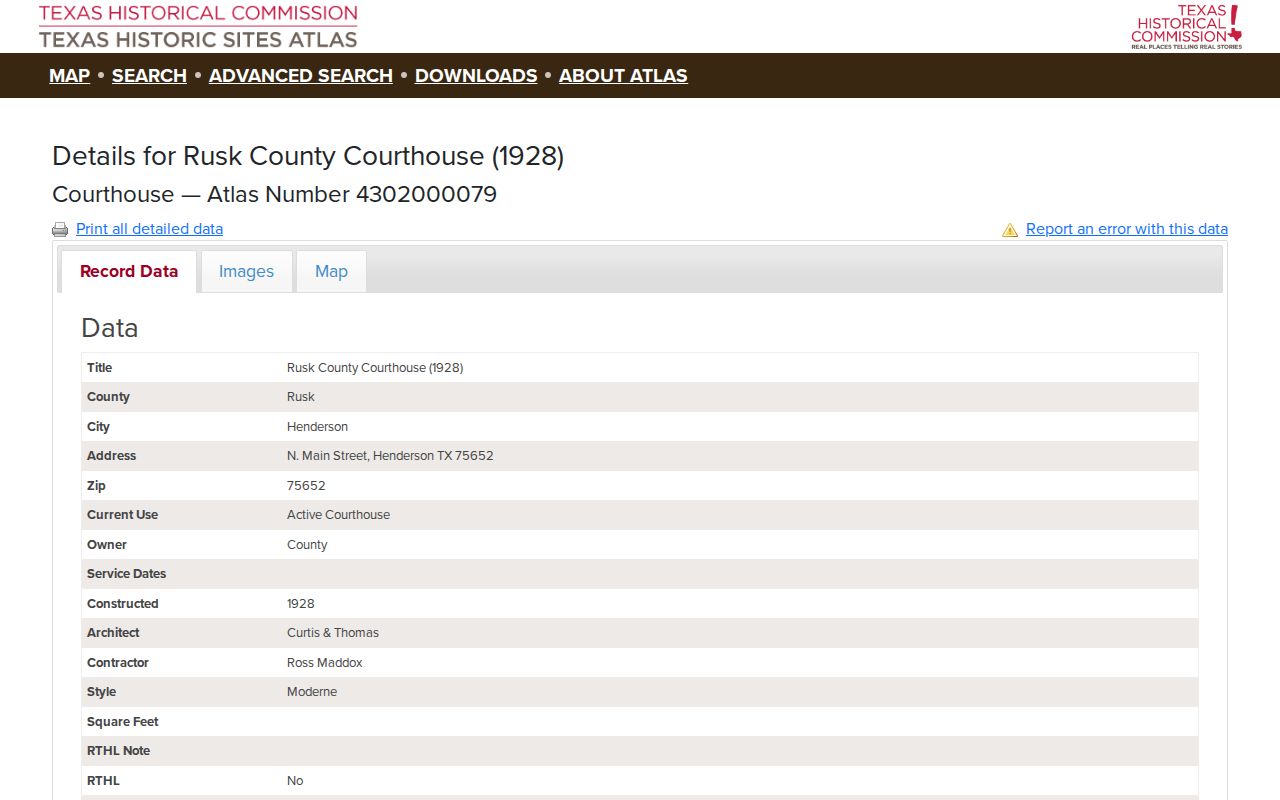
The Texas Historical Commission describes the current courthouse as a 1928 Moderne building, designed by Curtis and Thomas and built by Ross Maddox. Its exterior pairs brick with limestone, an elevated entry, horizontal courses, and metal bas-relief panels. The Atlas records 1984 cleaning and brick work. That entry is architectural history, not proof of a current landmark designation. The Texas Historical Commission Atlas holds the official architectural context.
Online dockets came long after this building, yet its offices still verify current records every day. For older digging, the trail may lead elsewhere. The Texas State Library lists county microfilm held at Stephen F. Austin State University, including Commissioners Court minutes from 1859 to 1870 and County Court minutes from 1878 to 1885. Those are archive holdings. Nothing there promises every volume is online.
Rusk County Docket Activity in Context
Read the Court Administration figures with their full labels. A District Court report dated June 18, 2025 covers activity through January 31, 2025. In its Rusk civil row, 796 cases were active and pending at the start, 128 were reactivated, 5,620 were added, 5,646 were disposed, 127 were placed inactive, and 689 were active pending at the end. Those are case-flow columns. They do not count unique people.
Municipal totals shift with each city and report column. Treat them as a way to read docket flow, not as a way to rank residents, cities, safety, or court quality.
Rusk County Court Dockets by City
Every municipal court runs its own docket route. The five cities below come from the OCA report's 2024 population column. Their pages cover local court dates, clerks, citation workflows, and search or payment tools. City cases do not land in the District Clerk index. They do not arrive there on their own.
Kilgore Docket Search
Kilgore separates hearing sessions from City Hall clerk work.
Henderson Docket Search
Henderson publishes citation guidance and local options.
Overton Docket Search
Overton offers a multi-field city search form.
Tatum Docket Search
Tatum uses a clerk-first access route.
Mount Enterprise Docket Search
Mount Enterprise publishes calendar and payment routes.
Justice-court tickets follow the clerk of the JP that issued them. The county warns that traffic tickets are not paid at the County Clerk.
Map and Directions to the Rusk County Courthouse
4th Judicial District Court files are kept at the Rusk County Courthouse, 115 N Main Street, in downtown Henderson. District Clerk civil, criminal, jury, and registry counters are on the third floor, Suite 303, with family-law service on the second floor. Felony arraignments sit Thursdays at 1:30 p.m. in the third-floor District Courtroom, and docket-call separates jail defendants at the Justice Center from other defendants in that courtroom.
Rusk County Courthouse - District Clerk
115 N Main Street, Suite 303
Henderson, TX 75652
(903) 657-0353
Jury and registry matters route to a separate extension, (903) 657-0325, and family filings are handled on the second floor at (903) 657-0348; calling ahead confirms the right counter and floor before a trip.